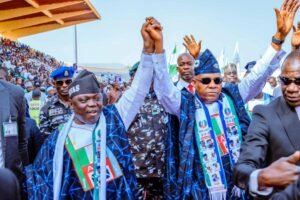

REWRITING HISTORY WILL NOT ERASE JONATHAN’S LEGACY: NIGERIANS BE THE JUDGE ON GEJ2027.
“When falsehood is repeated often enough, it risks becoming accepted as truth. But truth, like the sun, cannot be hidden forever.”
SETTING THE RECORDS STRAIGHT
The attention of the public has been drawn to the State House press statement of September 29, 2025, signed by Mr. Bayo Onanuga, which sought to diminish the record of former President Goodluck Ebele Jonatha, GCFR, while overstating the achievements of the present administration. For the sake of truth and history, it is necessary to set the records straight with verifiable facts.
1. ECONOMIC PERFORMANCE UNDER JONATHAN
Strong GDP Growth: Between 2010 and 2014, Nigeria’s GDP grew at an average of 6.5%, one of the fastest in the world (World Bank/IMF data). In 2013, following a rebasing exercise, Nigeria’s economy became the largest in Africa, valued at over $510 billion.
Diversification: Agriculture, services, and ICT recorded significant growth. Nollywood became the second-largest film industry globally, contributing over $7 billion annually to GDP.
Foreign Direct Investment: Nigeria attracted over $20 billion in FDI between 2010 and 2014 (UNCTAD data), ranking among Africa’s top destinations.
2. DEBT AND RESERVES MANAGEMENT
Debt Profile: As at May 2015, Nigeria’s total public debt stood at ₦12.12 trillion ($63.81bn), representing less than 13% of GDP (Debt Management Office, 2015). Today, under the current administration, public debt has surged past ₦100 trillion, raising sustainability concerns.
Reserves and Oil Revenue: In 2010, reserves were $45.9bn; by 2014, despite the global oil price crash from over $100 to below $50 per barrel, reserves stood at $34.5bn (CBN data). The decline was a global shock, not evidence of mismanagement.
Salary Bailouts: It is false that Jonathan’s Federal Government could not pay salaries. In 2014–2015, Jonathan approved ₦338 billion bailout funds for states struggling with salary arrears due to falling oil prices.
3. INSTITUTIONAL AND TRANSPARENCY REFORMS
President Jonathan introduced and implemented key reforms still in use today:
Treasury Single Account (TSA) – streamlined government revenues.
Integrated Payroll and Personnel Information System (IPPIS) – eliminated thousands of ghost workers.
Bank Verification Number (BVN) – strengthened banking transparency.
These reforms were internationally recognised by the World Bank and IMF as steps towards fiscal discipline.
4. SECURITY AND DEMOCRACY
By March 2015, Jonathan’s government had reclaimed 14 of 16 local government areas earlier seized by Boko Haram in the Northeast, with support from regional forces (Chad, Niger, Cameroon).
Most importantly, Jonathan made history by conceding defeat in the 2015 presidential election—the first peaceful transfer of power in Nigeria’s democratic history—earning global respect and stabilising the nation.
5. TINUBU’S CLAIMED “GIANT STRIDES” VS REALITY
While the State House highlights selective statistics, reality on the ground tells a different story:
Inflation: Headline inflation stands at 20.12% (NBS, Aug. 2025), but food inflation exceeds 31%, the highest in a decade, worsening hunger for ordinary Nigerians.
Poverty: Over 133 million Nigerians remain in multidimensional poverty (NBS, 2022), with no significant reduction since Tinubu assumed office.
Investment Climate: Despite claims of “investor confidence,” multinationals such as GlaxoSmithKline and Procter & Gamble exited Nigeria between 2023–2024, citing harsh economic conditions.
Debt Surge: Nigeria’s debt profile has more than doubled in two years, surpassing ₦100 trillion, despite record revenues from oil and taxes.
6. ON 2027 AND JONATHAN’S ELIGIBILITY
The press release questions Jonathan’s eligibility to contest. For clarity:
The Nigerian Constitution (Section 137) bars anyone elected twice as president not swearing in. Jonathan was elected once (2011) and completed the tenure of his late predecessor, Umaru Musa Yar’Adua.
Legal authorities and constitutional experts affirm his eligibility remains intact at least for a single tenure should he choose to contest.
CONCLUSION
Former President Goodluck Jonathan’s record is one of economic growth, democratic consolidation, and institutional reform—not the “disaster” described by the State House.
Attempts to rewrite history cannot erase:
Nigeria’s emergence as Africa’s largest economy under Jonathan.
His democratic sacrifice in 2015 that preserved national unity.
The enduring reforms still driving transparency in governance today.
Nigerians will judge leaders not by propaganda but by lived realities. In 2027, as always, sovereignty will rest with the people at the ballot box—not with press statements designed to distort history.
I repeat! History cannot be rewritten by press statements. The Nigerian people—and only the people—will decide the future in 2027.
“You may distort history for a season, but you cannot imprison truth forever. In the end, it is the people who will judge, not propaganda.”
Signed:
Nathaniel Michael Goodnews
Chairman PDP National Youth Movement, Bayelsa State Chapter.